Showing posts with label Economics. Show all posts

Sunday, January 18, 2015

On Taxes

Taxes are not something most people joyfully or gleefully pay. They are not something that most people claim to benefit from. But people defend taxation for various reasons; they are voluntary or compulsory. Taxes are what some describe as the cost of living in a certain area or to enjoy certain services that this money is supposedly collected for. And then some say all taxation is theft.  Apologists will denounce anyone who dares to "cheat" the system and keep some of their own money. They are a guilty pleasure and an unseen control mechanism to a lot of people.

Tax Time is here and not too many smiles will be found, unless you work for the Government that is...
Individuals and companies, from the last day of January to the 15th of April every year, sit down to try and figure out how much of their money has been taken by the Federal Government and if they can expect some of it back or if they will be forced to "give" some more. The Federal Income Tax has been enforced since 1913 and ever since that time people living in this country have been required to pay part of their wages to support government programs and fund Federal Institutions. Trillions of dollars are taken from the paychecks of citizens before they ever see it.


Why are you defending theft?
There is a saying "Taxation is Theft". Some believe this is an error and that the statement is false in all degrees. But is it? Is taxation theft? The legal definition of theft is the generic term for all crimes in which a person intentionally and fraudulently takes personal property of another without permission or consent and with the intent to convert it to the taker's use (including potential sale). With that said, one can question if the pay of a man for his labor is his property of that of the government for which he lives under. Questions can arise if the man has voluntarily submitted himself and his wages to the seizure of his property or if under the definition of theft has been the victim of a crime. Since those persons outside of government employment are in the private sector and those persons have not submitted the wages of their labor voluntarily, but by threat of violence or imprisonment the definition of theft can be applied to the act of taxation of income.
"If, then, taxation is compulsory, and is therefore indistinguishable from theft, it follows that the State, which subsists on taxation, is a vast criminal organization far more formidable and successful than any “private” Mafia in history". -Murray Rothbard-
Those that are in Employment of the government, in whatever capacity and at whatever level, (federal, state or local) are the beneficiaries of these extorted monies as their paycheck.
It has been said that these government workers "pay their own wages because they are taxed also". This is a fallacy. As a person is taxed at a percentage of their income, a person cannot pay into their entire paycheck. If they paid the entirety of their own wages it would be known as volunteering or slavery.


Oliver Wendell Holmes Jr., American Jurist and Associate Justice of the Supreme Court of the United States from 1902 to 1932 is quoted as saying, "Taxes are the price we pay for a civilized society." This is a popular thought of those who I would say taxation is a guilty pleasure or who feels that their wants should be funded by public means extorted from individuals instead of private and voluntary contributions. The very nature of this statement brings to mind a incredibly different question altogether for me. "Do we have a civilized society?"  That is a question left for another time.
A society based on the theft of wealth cannot be a moral and civil society. The very action of theft is against civility. But in this thought, we can ask ourselves these questions.
Does the act of paying into a general fund benefit the individual outright as much as it would if he would have funded whatever it is by voluntary means?
Can the value of these institutions to the general public be in contest to the value by the individual?
If a man be forced to fund policies and departments that they find immoral, unneeded, or in conflict with their religious or philosophical beliefs.


Murray Rothbard writes in his work "The Ethics of Liberty" that the size of government can be directly affected by the coercive nature of taxation. If the State were to suddenly abolish all taxation and thereby fund their departments and programs through completely voluntary means the size and scope of government would dramatically shrink.
This should be and is touted as the goal of the Neo-Conservatives and Republican Party,but is in complete contrast to their actions and policies. The same can apply to Democrats and Neo-Liberals, as their policies and actions tend to be based more on helping people, excessive taxation steals the money from people they are attempting to help.  It robs businesses of capital and forces higher prices, unemployment and subsequent poverty.


Where does all of this money go?
The mainstream belief is that these monies go to pay for services and programs inside and outside the United States. That would be nice, IF IT WERE TRUE. What is not taught to most Americans is that all the money that is taken in the form of the Federal Income Tax is used to pay off a loan for the previous fiscal year’s budgets. Who is this loan from?  The Federal Reserve loans the US government money at an interest rate. They then sell this debt (or securities) to foreign and domestic banks and individuals. The US Government pays these notes of security to the holders upon payment to the Federal Reserve of its loan. Of course the Federal Reserve does not pay the interest earned to the holders of the securities and instead makes a profit from the transactions. Interesting that a private bank that holds an enforced monopoly on the issuance of money is turning large profits off of the debt of a nation.
You might be wondering why the US debt has skyrocketed in the past and why it is so astronomical now; that is the nature of the Federal Reserve System. Since all money the government, and by mandate of the rest of the country, uses is owed back to the Fed with added interest; and the only way to pay it back is to take out a loan the next year, it is inevitable that this debt is unpayable. For a better explanation, I would recommend the book The Creature From Jekyll Island by G. Edward Griffin.


Is it cheating to keep your own money?
There are Tax Apologists out there that will become irate when an individual or company is found out to have offshore or international banking accounts in order to skirt paying taxes. The idea that someone who finds a way to keep his or her own property from seizure is seen as a criminal or seen as the bad guy has never really made sense. It is the same as someone who sets an alarm on their car or home: they are protecting their property and assets. The keeping of their own wages or property is the essential goal of Tax abolitionists which is to free everyone of the burden of theft of wages. It’s baffling to think that anyone is against this, but I think the emotional and illogical thought people have is, " If I have to pay then so does everyone else." i.e. the fair tax. To be certain there is nothing fair about the Fair Tax, it is still funneling money away from commerce and savings and it still only applies to certain groups and individuals.


The Fair Tax advocates will debate all day long that their system is better than what we have now, and I will not disagree, however I will say this: it is far from an ideal way to handle things. The entire idea of collecting money to fund programs and departments that the original "victim" may not have voluntarily given to is still present. The idea that money is still being diverted away from private enterprise and given to a bloated, inefficient and expanding government hasn’t changed. The same idea that Rothbard stated is still there: if the department or program cannot be funded by voluntary means it should not be fit to survive on public funding. Much like private business, if customers do not value the product or service, the company will fail and cease to exist. In the opposite of public departments and government offices, there is no measuring stick or ruler to determine if the service is viable beyond the edicts of bureaucrats and politicians wants.
To name a few things that tax monies are used for that would most likely not be funded by voluntary means.
The NSA and its wiretapping programs- Seen as a violation of privacy by a majority, this office and its "service" most likely would fall.
Animal Shelters that euthanize animals- This is a partial subsidy most often and the shelter may or may not survive with voluntary contributions.
The Militarization of America's Police forces and the brutality that they commit on a daily basis-If these police departments were reliant on the surrounding communities support and contributions there would be less of a chance they would commit the heinous acts that they do. Killing family pets and even people are becoming everyday occurrences in America. Changing the way they are funded could force them to rely on community service and protection services without the God Complexes a lot of them have.


Calling on more taxation.
There is a growing movement in America, an added Tax movement. The Robin Hood Tax or The Wall Street Tax is the next big thing for gluttons for monetary punishment. This new tax would add tax onto Wall Street transactions. If any sane individual thinks that this would not have a detrimental effect on the Stock Market, they are gullible and economically ignorant. Any addition to transactions coming from Wall Street would hamper the degree and volume of daily transactions. This would have a negative impact on the formation and expansion of companies and corporations as they will stifle new markets and products. These new taxes, like all others, will be passed to the end consumers, YOU AND I. When a new tax or regulation is added to a transaction of a corporation, the owners of that company will want to reduce any interference in their ability to turn profits (after all everyone is after a profit). That is the reason most of us have jobs; to profit off of our skills and labor. The owners will pass their cost of compliance to regulation or the collection of new taxes down the line until it hits the product on the shelf where the end user, the consumer, picks up the higher price.


As an Anarcho-Capitalist, I understand that this is hard for some to understand and takes much more than a simple blog post by a relative unknown person for many to grasp the concepts I have laid out here. That is why I encourage further reading into the failure and immorality of taxation.  The works of Ludwig von Mises, Murray N Rothbard, Lew Rockwell and so many more are easily found online. Take the time and educate yourself. Learn and apply, it really is that easy.

Also Follow me on these other Social Media Sites
Twitter @PatriotPapers
FaceBook https://www.facebook.com/travis.wilson.355744

Sunday, December 14, 2014

America Does Not Have A "Free Market Capitalist" Economy

I say quite often that America does not have a Free Market Capitalist economic system and sometimes the befuddled looks I get from those that hear this provokes them to question what I mean by it. The answer is simple and can be broken down into two parts, the two definitions of what is being asked.

"What is a Free Market?" and "What is Capitalism?"

The answers to these two questions together with an understanding of the current mode of economic activity gives a clear indication that the statement, "America does not have a Free Market economic system" is true.

So what is a free market economic system?
Free Market principles point to an economic system where business are unfettered by regulation, licensing, special fees and taxation, a system where all manner of salable goods are on the market without prohibition or exclusion. It is a system where the buying habits of those consumers would drive the manufacturers and distributors to produce or stock items that were valued by customers and discontinue or remove goods that have lost favor or marketability and sales numbers. This provides that customers are able to actually drive the economy by their buying habits and wants, without the interference of an outside entity.

This would of course be in contrast to the current system of high regulation, increasing taxation, special licencing, educational requirements and so on the American system is plagued by. Economists who advocate this idea of unfettered markets, also see that allowing prices and wages to form naturally and the availability and manufacture of goods to lie in the interest of those who have the capability to produce and the want to produce in trade for profit is a nearly unfailing concept in the ways of maximum efficiency of producers as well as maximum favorable market conditions for consumers.

With this some may say that the deregulation of businesses will (could/would) lead to businesses being able to skirt environmental concerns, livable wages, price gouging, and so on. In response to this one can argue on the case of environmental concerns that the information that a retailer or manufacturer was damaging the environment, the consumers voice could be heard by lowering or altogether abandoning or boycotting the product, manufacturer and retailers and distributors. When profits and sales decrease a signal is sent that certain practices are not favorable or condoned. This is the aspect of "market self regulation".

On the issue of wages. Wages should be set by employer and employee. If in the scenario an employer is offering too little pay the potential employee can ask for more or refuse. By no means should the wage of any person be determined by anyone other than the laborer and the job provider. In the system we have now wages are set by government decree, in an attempt to make a fair wage government actually provides yet another hurdle for a prospective employee to jump in order to gain employment. If the set wage is too high for the business, they will refuse to hire. Minimum wage laws also hinder the ability of these businesses to adjust wages based on experience of each employee, there is always a floor that they cannot overcome. Again a control on the level of wages offered by businesses is not a Free Market principle. It is a system of control.

Pricing controls work similar to wage controls, being that wages are prices and vice-versa, it stands that any interference in the marketable value being set by someone other than the seller negates the definition of free market practice.

So what is Capitalism?

Capitalism is defined many ways depending on the social structure lense those defining it look through. To make this easier we can go with two differing opinions, one from Wikipedia (which I use because of it's high use of editing from other editors) and then a definition from the website WorldSocialism.org (including this one because it highlights the idea that the word has different meanings depending on who you ask and how they define it).
According to Wikipedia Capitalism is "is an economic system in which trade, industry, and the means of production are largely or entirely privately owned and operated for profit. Central characteristics of capitalism include capital accumulation, competitive markets and wage labor.  In a capitalist economy, the parties to a transaction typically determine the prices at which assets, goods, and services are exchanged."  This is the definition, or close to it, that most non socialists agree upon.

With this definition in mind we can see that there are a large number of businesses and services that are not privately owned, ran, or funded but are so called public services and are controlled by government, whether county, state, or federal, and are funded through taxation instead of consumerism. This leads me, to say that we may define America as a mixed economy, but definitely not a pure Capitalist economy.

According to the website WorldSocialism.org though Capitalism is something to be feared and abhorred based on their claim of worker exploitation. The definition they detail is,"Capitalism is the social system which now exists in all countries of the world. Under this system, the means for producing and distributing goods (the land, factories, technology, transport system etc) are owned by a small minority of people. We refer to this group of people as the capitalist class. The majority of people must sell their ability to work in return for a wage or salary (who we refer to as the working class.)"

They go on to say,"The working class are paid to produce goods and services which are then sold for a profit. The profit is gained by the capitalist class because they can make more money by selling what we have produced than we cost to buy on the labor market. In this sense, the working class are exploited by the capitalist class. The capitalists live off the profits they obtain from exploiting the working class whilst reinvesting some of their profits for the further accumulation of wealth."

And with this in mind we can ask the socialist this question, "isn't the worker also a capitalist, as they value their time and effort less than the wage they are paid? If they did not value the wage more than the time or effort they would not work, as in a socialist society, goods are given freely based upon need and taken based upon production, or better said by their economic muse Karl Marx, "From each according to his ability, to each according to his need". This proclaims that no matter how productive you are, your effort is only for the benefit for the others who wish not to work or do not perform as you do. What incentive does that leave to work hard, or even harder? What incentive does that leave to work at all? What incentive does that leave to create, to innovate, or to improve upon goods? If there is no benefit for someone to excel at a good or service it will be done at a minimum speed and quality.


With that being said we can look at the American economy as a partial capitalist economy and a partial socialist economy. There are many areas that the State has complete control over production or service. Roads, Schools, Protection Services, Old Age Insurance are a few of the largest and easiest to see. In that the capitalist is still beholden to government entities in order to start or continue in their business. We can also see THAT is in no way a "free market" system.

Saturday, December 6, 2014

Austrian Economics with Glenn Jacobs


This economic presentation with Glenn Jacobs, aka Kane, was documented on September 5, 2013. 

0:00:00 - 1:03:16 - Austrian Economics Presentation
1:03:30 - 1:16:33 - Q & A 

"It really ticks me off when I hear leftists and statists talk about how the free market causes wealth inequality, the free market doesn't. The free market though out history has allowed poor people to pull themselves up and has given people more socio economic ability to move up and down the socio economic ladder, up, than anything else in history.
Paul Krugman, who is a keynesian economist par excellence, just wants to inflate like crazy, but yet he writes a column for the New York Times and it's called 'Conscience of a Liberal', because he loves poor people despite the fact that he's the guy that's killing them, but then he'll look at someone like me and say you hate the poor. I don't hate the poor, I hate the fact that they're poor." 
—Glenn Jacobs (41:33 - 42:22)


Monday, November 24, 2014

Can Anarcho-Capitalism Work? by Lew Rockwell

Can Anarcho-Capitalism Work?

NOVEMBER 14, 2014
This talk was delivered at the Costa Mesa Mises Circle on Society Without the State, November 8, 2014.
The term “anarcho-capitalism” has, we might say, rather an arresting quality. But while the term itself may jolt the newcomer, the ideas it embodies are compelling and attractive, and represent the culmination of a long development of thought.
If I had to boil it down to a handful of insights, they would be these: (1) each human being, to use John Locke’s formulation, “has a property in his own person”; (2) there ought to be a single moral code binding all people, whether they are employed by the State or not; and (3) society can run itself without central direction.
From the original property one enjoys in his own person we can derive individual rights, including property rights. When taken to its proper Rothbardian conclusion, this insight actually invalidates the State, since the State functions and survives on the basis of systematic violation of individual rights. Were it not to do so, it would cease to be the State.
In violating individual rights, the State tries to claim exemption from the moral laws we take for granted in all other areas of life. What would be called theft if carried out by a private individual is taxation for the State. What would be called kidnapping is the military draft for the State. What would be called mass murder for anyone else is war for the State. In each case, the State gets away with moral enormities because the public has been conditioned to believe that the State is a law unto itself, and can’t be held to the same moral standards we apply to ourselves.
But it’s the third of these ideas I’d like to develop at greater length. In those passages of their moral treatises dealing with economics, the Late Scholastics, particularly in the sixteenth and seventeenth centuries, had been groping toward the idea of laws that govern the social order. They discovered necessary cause-and-effect relationships. There was a clear connection, for example, between the flow of precious metals entering Spain from the New World on the one hand, and the phenomenon of price inflation on the other. They began to understand that these social regularities were brute facts that could not be defied by the political authority.
This insight developed into fuller maturity with the classical liberals of the eighteenth century, and the gradual emergence of economics as a full-fledged, independent discipline. This, said Ludwig von Mises, is why dictators hate the economists. True economists tell the ruler that there are limits to what he can accomplish by his sheer force of will, and that he cannot override economic law.
In the nineteenth century, Frédéric Bastiat placed great emphasis on this insight. If these laws exist, then we must study them and understand them, but certainly not be so foolish as to defy them. Conversely, he said, if there are no such laws, then men are merely inert matter upon which the State will be all too glad to impose its imprint. He wrote:
For if there are general laws that act independently of written laws, and whose action needs merely to be regularized by the latter, we must study these general laws; they can be the object of scientific investigation, and therefore there is such a thing as the science of political economy. If, on the contrary, society is a human invention, if men are only inert matter to which a great genius, as Rousseau says, must impart feeling and will, movement and life, then there is no such science as political economy: there is only an indefinite number of possible and contingent arrangements, and the fate of nations depends on the founding father to whom chance has entrusted their destiny.
The next step in the development of what would later become anarcho-capitalism was the radical one taken by Gustave de Molinari, in his essay “The Private Production of Security.” Molinari asked if the production of defense services, which even the classical liberals took for granted had to be carried out by the State, might be accomplished by private firms under market competition. Molinari made express reference to the insight we have been developing thus far, that society operates according to fixed, intelligible laws. If this is so, he said, then the provision of this service ought to be subject to the same laws of free competition that govern the production of all other goods. Wouldn’t the problems of monopoly exist with any monopoly, even the State’s that we have been conditioned to believe is unavoidable and benign?
It offends reason to believe that a well-established natural law can admit of exceptions. A natural law must hold everywhere and always, or be invalid. I cannot believe, for example, that the universal law of gravitation, which governs the physical world, is ever suspended in any instance or at any point of the universe. Now I consider economic laws comparable to natural laws, and I have just as much faith in the principle of the division of labor as I have in the universal law of gravitation. I believe that while these principles can be disturbed, they admit of no exceptions.
But, if this is the case, the production of security should not be removed from the jurisdiction of free competition; and if it is removed, society as a whole suffers a loss.
It was Murray N. Rothbard who developed the coherent, consistent, and rigorous system of thought — out of classical liberalism, American individualist anarchism, and Austrian economics — that he called anarcho-capitalism. In a career of dozens of books and thousands of articles, Rothbard subjected the State to an incisive, withering analysis, unlike anything seen before. I dedicated Against the State to this great pioneer, and dear friend.
But can it work? It is all very well to raise moral and philosophical objections to the State, but we are going to need a plausible scenario by which society regulates itself in the absence of the State, even in the areas of law and defense. These are serious and difficult questions, and glib answers will naturally be inadequate, but I want to propose at least a few suggestive ideas.
The conventional wisdom, of course, is that without a monopoly provider of these services, we will revert to the Hobbesian state of nature, in which everyone is at war with everyone else and life is “solitary, poor, nasty, brutish, and short.” A ceaseless series of assaults of one person against another ensues, and society sinks ever deeper into barbarism.
For one thing, it’s not even clear that the logic behind Thomas Hobbes’s fears really makes any sense. As Michael Huemer points out, Hobbes posits a rough equality among human beings in that none of us is totally invulnerable. We are all potential murder victims at the hands of anyone else, he says. He likewise insists that human beings are motivated by, and indeed altogether obsessed with, self-interest.
Now suppose that were true: all we care about is our own self-interest, our own well-being, our own security. Would it make sense for us to rush out and attack other people, if we have a 50 percent chance of being killed ourselves? Even if we happen to be skilled in battle, there is still a significant chance that any attack we launch will end in our death. How does this advance our self-interest?
Hobbes likewise speaks of pre-emptive attacks, that people will attack others out of a fear that those others may first attack them. If this is true, then it’s even more irrational for people to go around attacking others: if their fellows are inclined to preemptively attack people they fear, whom would they fear more than people who go around indiscriminately attacking people? In other words, the more you attack people, the more you open yourself up to preemptive attacks by others. So here we see another reason that it makes no sense, from the point of view of the very self-interest Hobbes insists everyone is motivated by, for people to behave the way he insists they must.
As for law, history affords an abundance of examples of what we might call trickle-up law, in which legal norms develop through the course of normal human interaction and the accumulation of a body of general principles. We are inclined to think of law as by nature a top-down institution, because we confuse law with the modern phenomenon of legislation. Every year the world’s legislative bodies pour forth a staggering number of new rules, regulations, and prohibitions. We have come to accept this as normal, when in fact it is, historically speaking, an anomaly.
It was once common to conceive of law as something discovered rather than made. In other words, the principles that constitute justice and by which people live harmoniously together are derived from a combination of reflection on eternal principles and the practical application of those principles to particular cases. The idea that a legislative body could overturn the laws of contract and declare that, say, a landlord had to limit rents to amounts deemed acceptable by the State, would have seemed incredible.
The English common law, for example, was a bottom-up system. In the Middle Ages, merchant law developed without the State at all. And in the US today, private arbitration services have exploded as people and firms seek out alternatives to a government court system, staffed in many cases by political appointees, that everyone knows to be inefficient, time-consuming, and frequently unjust.
PayPal is an excellent example of how the private, entrepreneurial sector devises creative ways around the State’s incompetence in guaranteeing the inviolability of property and contract. For a long time, PayPal had to deal with anonymous perpetrators of fraud all over the world. The company would track down the wrongdoers and report them to the FBI. And nothing ever happened.
Despairing of any government solution, PayPal came up with an ingenious approach: it devised a system for preemptively determining whether a given transaction was likely to be fraudulent. This way, there would be no bad guys to be tracked down, since their criminal activity would be prevented before it could do any harm.
Small miracles like this take place all the time in the free sector of society, not that we’re encouraged to learn much about them. Recall that as the Centers for Disease Control issued false statements and inadequate protocols for dealing with Ebola, it was a Firestone company town in Liberia that did more than any public authority in Africa to provide safety and health for the local population.
There is a great deal more to be said about law and defense provision in a free society, and I discuss some of this literature at the end of Against the State. But the reason we focus on these issues in the first place is that we realize the State cannot be reformed. The State is a monopolist of aggressive violence and a massive wealth-transfer mechanism, and it is doing precisely what is in its nature to do. The utopian dream of “limited government” cannot be realized, since government has no interest in remaining limited. A smaller version of what we have now, while preferable, cannot be a stable, long-term solution. So we need to conceive of how we could live without the State or its parasitism at all.
The point of this book is to speak frankly — at times perhaps even shockingly so — in order to jolt readers out of the intellectual torpor in which the ruling class and its system of youth indoctrination have lulled them. We might have a fighting chance if most people were aware of the ideas in this book, and in our intellectual tradition generally. They would never fall for the State’s propaganda line, its apologias, its moral double standards. They would be insulted by these distortions and dissimulations.
And that’s what we do at the Mises Institute. We don’t publish “policy reports” in the vain hope that Congress will defy its own nature and pursue freedom. Every one of those policy reports winds up in the trash can. They are used to dupe the gullible into thinking the Washington think-tanks they support have influence in Washington.
Instead, we set forth the truth about the State without compromise or apology. The reason Ron Paul attracted so many young people was that they could see he was speaking to them in plain English, not politicalese. He was speaking frankly and truthfully, without regard for the lectures and hectoring he’d get for it at the hands of the media.
We’ve tried to emulate Ron’s approach — and of course, we’ve been delighted to have Ron as a Distinguished Counselor to the Institute since its inception, and as a member of our board as well. The stakes are too high for us to do anything other than speak frankly and directly about what we know to be true. It’s easy to publish toothless essays about public policy. It is harder to focus on war, the Federal Reserve, and the true nature of the State itself. But that is the path we have willingly chosen.
We hope you’ll join us.
Image source: iStockphoto.

Tuesday, November 18, 2014

Working on Thanksgiving Day? Good.

Why is it being seen as a bad thing for people to be working and businesses to be open? And why is this only aimed at retail workers?

There is growing discontent at retailers who have chosen to open their stores on Thanksgiving day this year in an effort to bring in more sales. The discontent felt by many is in response to their feeling that those retailers are taking advantage of their workers and forcing them to work these hours. Though the federal government in the US has recognized Thanksgiving as a holiday, there is not a mandate in place that requires all workers to be let off for the day, at least not yet. Unless specifically implied in an employment contract companies can require their employees to work hours that they set or days that may not be in accordance to "the norm" set by others. But this should not be seen as a bad thing.

In the theory that prices are wages and vice versa, those that are employed and work on these days are adding to the personal income while the employers are adding to their own sales numbers, cost and benefits to both.  All the parts to the market process win in this scenario. The worker earns his wage, allowing him to purchase goods. The consumer is able to buy goods, with their own wages, on an open schedule and with workers to run the transactions. The employer or business has both workers and consumers participating in the system. Allowing for both sides of the transaction the business has facilitated trade and helped a worker to earn a wage, in lieu of their labor. It really is a win-win-win situation.

They (the public at large) want employment. They want more products. They want consumerism. But they also want the ability to regulate who can work, where they can work, when they can work, and for how long they can work.
They want control over the businesses, not through market participation (or non-participation) but through the hand and fist of government. (This is a petition aimed at government workers, but others have been started to mandate holidays off for some industries, excluding some at the same time.)
They want to be able to buy their widgets, at low prices, with high wages for the workers and paradisaical hours and schedules without the hindrance of anyone else's wishes to be inconvenienced  by unopened stores or working late night hours. Quite Utopian a task to regulate such a feat to not impose on the wishes of others, or to not have your own wishes imposed upon.

It really is no surprise that there is the feelings of disgust and opposition towards holiday working hours and they are not aimed at the workers themselves directly,  they are aimed at the economic position of the worker, the business and the shopper alike. All of these work in unison to create the market, and the more regulation in the way hinders one or all of these three in some way.

Now this is only addressing the retail stores that are to be open on Thanksgiving day but take this a bit further in the thought process and we see what others miss. If we were to say that the retailers were to be forced to not open on specific days, holidays in fact, why would we not extend this same idea to all facets of service to others. Bus Stations, Airports, Rescue Workers, maybe even to force prostitutes and drug dealers to refrain from work by decree, all areas of services to others should be  In the name of mandated fairness that so many call for why should any of these other services be able to operate? Air travel should come to a halt for 24 hours, Policemen and women able to spend the day with their families, prostitutes forced to not take clients for one full day. If this idea is really in the name of allowing those workers in retail to have time with their family on any given day, this extended idea should be of no debate, it is after all in the name of the family structure and fairness. So we have to look at the long reaching effects of what is being proposed. Gas stations closed, toll booths and the roads the are on closed. Grocery stores closed. Not being able to run and get that one last piece for a joyful holiday all because working on holidays had been regulated away.  Every business following suit of retailers and being forced to close for one whole day.


Friday, October 10, 2014

Mises Daily: How Saving Grows the Economy by Dan Sanchez

How Saving Grows the Economy

Mises Daily: Friday, October 10, 2014 by 
A
A
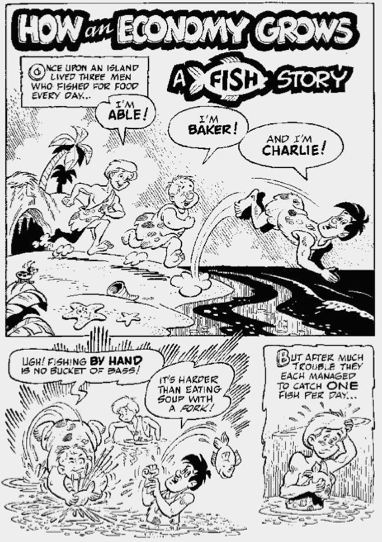
Back in the 1980s, Irwin Schiff, anti-tax activist, political prisoner, and father of free-market pundit Peter Schiff, wrote a marvelous comic book titled How an Economy Grows and Why It Doesn’t, which teaches economic principles through a light-hearted story.
The comic starts with three islanders — Able, Baker, and Charlie — who live off of fish, which they catch in the sea. They have no tools to aid them, so they must fish with their bare hands. Fish, to the islanders, is a consumers’ good: something that is used to directly pursue their goals (in this case, the goals of satisfying hunger and not starving). But, fish can only be a consumers’ good when it is ready for consumption. The fish do the islanders no good while they are still swimming in the sea. So the islanders must engage in production. They must produce the product of “fish on a plate,” which is, to be exact, the true consumers’ good, and not simply “fish” per se.
To produce “fish on the plate,” the islanders must use productive resources, or factors of production. One factor the islanders must use is their own labor. In this case, their labor is the act of fishing: using their eyes to spot the fish, and their hands to grab them. Another factor they must use is land, or natural resources: in this case, “fish in the sea.” “Fishing labor” + “fish in the sea” = “Fish on the plate.”
Using only their bare hands, the islanders can only produce one fish per day, which is very lowproductivity.
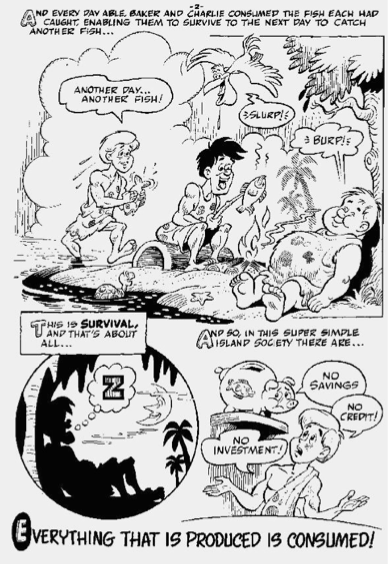
As Schiff writes, with such low productivity, “This is survival and that’s about all.” It is a state of extreme poverty. The islanders have little time for leisure, or to produce anything else they might want to enjoy. They are also extremely vulnerable. What if they get sick, or break their hand? A single bad week of fishing could mean starvation. Life with such low productivity, is life on the brink.
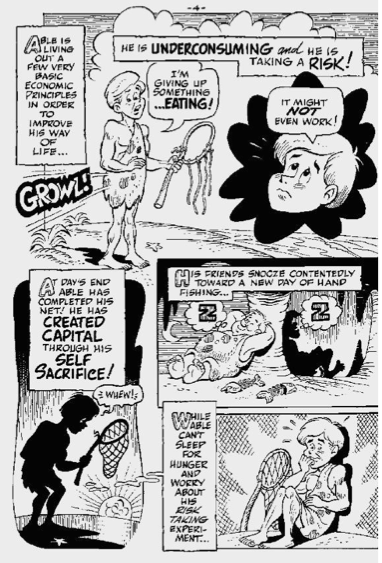
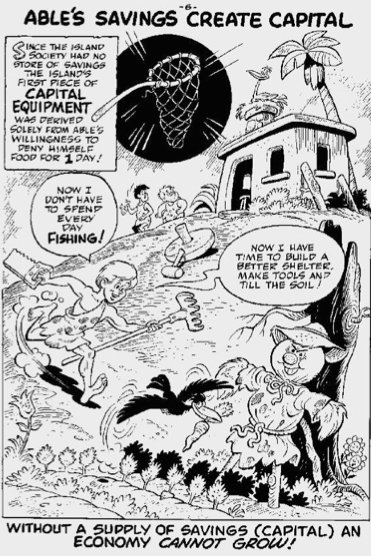
Like a Disney princess, Able dreams of “something more.” He’s tired of being poor, and wants to somehow improve his living standard. He comes up with the idea of building a net to use to catch fish faster (boost his productivity).
The net is a third kind of factor: a capital good, or produced factor of production. Producing a net also requires factors, including natural materials (land), like sticks and vines, and net-building labor. Building the net would take a whole day.
That would be a whole day that Able wouldn’t be fishing. His labor is scarce; it cannot be dedicated to both fishing and net building at the same time, and so it must be economized: dedicated to one and not the other.
And if Able doesn’t fish, he goes hungry for that day. Building the net would require sacrifice:delaying consumption.
Able must decide between two different production methods. Does he stick to hand fishing, or does he switch to net fishing? He must consider the upsides and downsides of each.
The upside of hand fishing is that it has a short period of production. Able starts production, and then gets to eat later that very same day. The downside is its low productivity, and Able’s resulting chronic state of poverty.
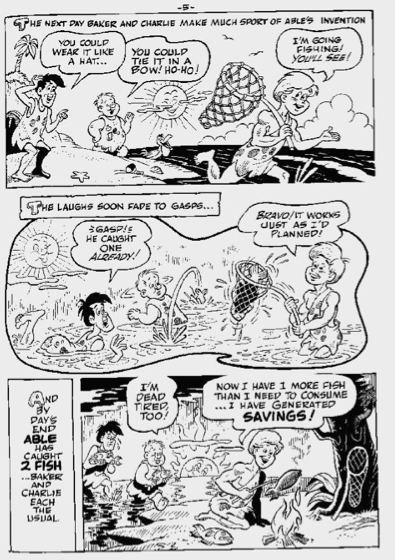
The upside of net fishing is its higher productivity, which is two fish per day according to the comic; but for illustrative purposes, let us change the productivity of net fishing to three fish per day. The downside of net fishing is that it has a longer period of production at first. It takes one day to make the net, and then another day to use it. So, Able would start production, and only get to eat two days later.
Able is at a crossroads. He can either stay mired in primitivism, or he can rise above it. Rising above economic primitivism is often considered simply a matter of technology. However, simply having the idea of, and the know-how for, producing a net, is not an immediate, costless benefit for Able. It would be costless if it were simply a matter of choosing between “1 fish today” and “3 fish today.” Of course more is automatically better than less, other things being equal. But other things are not equal: a difference regarding time is an essential consideration here. It is not simply more vs. less; it is “more and later” vs. “less and sooner.”
So the decision for Able whether to adopt the “net fishing” technology involves a trade-off: an “exchange” he deliberates over in his mind. Will he give up the “less and sooner” yield that comes with hand fishing in exchange for the “more and later” yield that comes with net fishing?
The answer to that depends on Able’s personal time preference, or the premium he places on the immediacy with which he achieves his ends: the importance of “sooner.” The lower someone’s time preference is, the more willing someone will be to delay consumption. And the higher, the less.
For example, as the comic book later indicates, the time preferences of Baker and Charlie are too high for them to make the net. Giving up eating today is too great a sacrifice for them, even if it would mean being able to eat three times as much tomorrow. If net fishing were more productive, that might have sweetened the deal enough; i.e., if the net netted five times as much, they might have been willing to wait. Their time preferences are not infinitely high. But they are not low enough to embark on this particular capital project.
But Able’s time preference is low enough, so he is willing to delay consumption, produce the capital good, and increase his productivity.
Morevoer, the day after his first big net-aided catch, he has enough extra fish to not have to fish all day, because he can subsist on what he has already caught. Instead, he can spend the day creating even more capital goods to raise his productivity even higher. For example, he makes a rake to use to farm carrots. And he can use the additional yield from carrot farming to support even more capital accumulation. As he becomes ever more productive, he can also afford to devote more resources toward leisure and comfort as well.
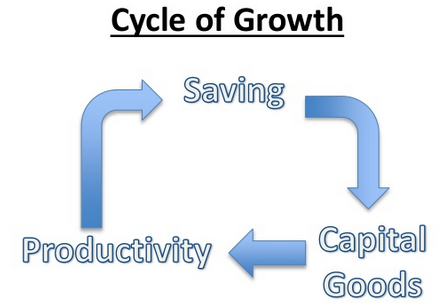
Thus, Able’s low time preference puts him in the fast track of an ascending spiral: a virtuous “Cycle of Growth.” Saving (delaying consumption) supports more capital goods, which boosts productivity, which creates more to save, and around he goes.
With every lap around this loop, he becomes wealthier, as both his capital stock and living standard increases. And with every lap, he inches ever further away from the brink and toward greater security and peace-of-mind. A bad week of production becomes merely a bummer, and not a catastrophe. This Cycle of Growth, by the way, is the way living standards rise in a complex market economy as well.
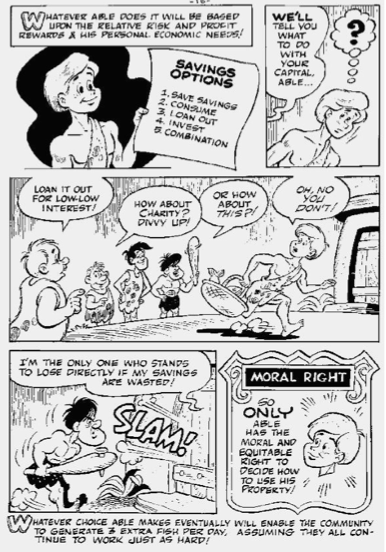
But then others on the island start getting their own ideas about what Able should do with his newly abundant resources. One man says, “Divvy up.” This is an example of the envy-based egalitarian ethos that has afflicted peoples throughout history and pre-history, keeping them poor and primitive. As Murray Rothbard wrote:
In fact, the primitive community, far from being happy, harmonious, and idyllic, is much more likely to be ridden by mutual suspicion and envy of the more successful or better favored, an envy so pervasive as to cripple, by the fear of its presence, all personal or general economic development. The German sociologist Helmut Schoeck, in his important recent work on Envy, cites numerous studies of this pervasive crippling effect. Thus the anthropologist Clyde Kluckhohn found among the Navaho the absence of any concept of “personal success” or “personal achievement”; and such success was automatically attributed to exploitation of others, and, therefore, the more prosperous Navaho Indian feels himself under constant social pressure to give his money away. Allan Holmberg found that the Siriono Indian of Bolivia eats alone at night because, if he eats by day, a crowd gathers around him to stare in envious hatred.
If every time someone saves more, he is pressured to relinquish his “excess wealth,” that can only discourage savings. And knocking out savings knocks people off the Cycle of Growth. It also knocks them onto a Cycle of Impoverishment. This is because low savings can lead to capital consumption. “Consuming” capital doesn’t mean “eating the net.” It means that the net eventually wears out with use, and to maintain it requires diverting possibly consumed resources away from consumption and toward repair/replacement. Without sufficient savings, capital goods enter a state of disrepair. The net eventually tears and fish start swimming through it, at which point the fisherman must resort again to low-productivity hand-fishing, and finds himself back on the brink.
Another islander waves a club at Able, and suggests, “How about this?” threatening to plunder Able’s savings. Such brigandage has also kept entire peoples poor throughout history and pre-history. Constant raids by roaming hordes will also discourage savings and break the Cycle of Growth. Sometimes the raiders settle in, and, through propaganda, transform themselves into a “state,” and their plunder into “taxation.” What is particularly devastating to the Cycle of Growth is the kind of state plunder called, “proscription.” In ancient times, when an individual managed to accumulate enough wealth, he often became a tempting one-stop shop for loot, and so the state would find some excuse to imprison or execute him so as to facilitate his total expropriation. This explains the rage for “buried treasure” in times and places where princes were particularly grasping. Of course, modern democracies plunder too, often under the cover of egalitarianism and through “progressive taxation.” The more you save, the more you’re taxed. This too is particularly inimical to the Cycle of Growth.
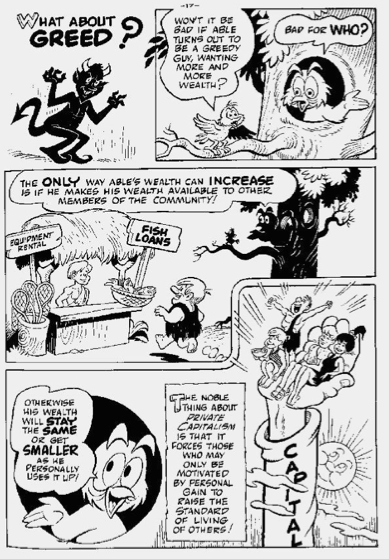
Then a little bird asks if Able’s penchant for accumulation is “greedy” and bad. “Bad for whom?” responds a wise owl. There are only so many fish Able can eat, and only so many uses for his nets. To maximally benefit from his tremendous productivity, he must offer his products to others in the community in exchange for goods and services. And through exchanges like investments, loans, and wages, non-savers can get access to capital goods that would have otherwise been out of reach. For example, Able rents out his nets and loans out his fish at interest. This enables higher-time-preference islanders like Baker and Charlie to increase their productivity and living standards. And since all exchanges are, by definition, projected by both willing parties to be beneficial, the more exchanges the saver makes, the more he benefits the public.
Savings and capital benefit everyone, not just the saver and capital accumulator. The Cycle of Growth lifts the entire community. And so when egalitarianism and plunder discourage saving, it keeps the entire community down, hurting not only the savers, but everyone who might have exchanged with the savers.
There is nothing “fishy” about savings, capital accumulation, productivity, and peacefully acquired wealth. But to paraphrase an old saying, fish and plundering visitors start stinking very quickly.
As Ludwig von Mises wrote:
Every single performance in this ceaseless pursuit of wealth production is based upon the saving and the preparatory work of earlier generations. We are the lucky heirs of our fathers and forefathers whose saving has accumulated the capital goods with the aid of which we are working today. We favorite children of the age of electricity still derive advantage from the original saving of the primitive fishermen who, in producing the first nets and canoes, devoted a part of their working time to provision for a remoter future. If the sons of these legendary fishermen had worn out these intermediary products — nets and canoes — without replacing them by new ones, they would have consumed capital and the process of saving and capital accumulation would have had to start afresh. We are better off than earlier generations because we are equipped with the capital goods they have accumulated for us.